



Impacts & Systems
Environmental And Social Impacts And Management System
Redstone CSP
Environmental and Social Impacts and Management System
The Redstone CSP project is a Greenfield Independent Power Project (IPP) developed as part of South Africa’s renewable IPP program. The project will be developed on a BOO (build, own, operate) with a total power generating capacity of 100 MW net power output. The project will be equipped with the largest thermal storage size ever adopted in South Africa and is among the most efficient solar plants in the world operating in this class of capacity and technology yielding a record high generation in excess of 480 GWh/year to support the power grid of South Africa.
Our key aim with respect to the environmental and social issues arising from with CSP plants, is to appropriately reduce negative and harmful impacts on people and the environment and enhance the positive impacts through effective consultation with the locally community, during both construction and operation phases. Information concerning how we will address the potential issues during the construction and operations of the CSP plant is summarized in the following paragraphs:
Water Management
Water will be used mostly for dust suppression, heliostat cleaning and compaction purposes and will be sourced from the Vaal-Gamagara pipeline from the Sedibeng authority.
Dust Management
During construction dust suppression techniques using water trucks will always be employed to mitigate against activities like ground clearance, vehicle movement and excavation to reduce the impact on our close communities and other operations.
Sewage
Domestic wastewater and sewage will be captured in combined waste streams and directed to a sewage package treatment plant. The sewage package treatment plant will be required to achieve legislated effluent quality discharge standards. Effluent will be pumped to the evaporation ponds. The fully treated solids will be disposed at an appropriately licensed waste disposal facility. All processes will be monitored to ensure that they remain effective.
Solid waste
Significant and diverse waste stream is expected to be generated during construction. A construction waste management plan (CWMP) has been drafted and encompasses plans for solid wastes and wastewater generated during the construction phase of the project and describes several techniques or control measures.
Soil erosion management and surface hydrology
During construction, vehicular traffic on the construction site will be kept to well-defined roads or delimited zones as far as possible. Proper road drainage procedures will be put in place and maintained to convey any surface water off the roads and into undisturbed areas.
Wastewater and storm water
During construction, proper road drainage procedures will be put in place and maintained to convey any surface water off the roads and into undisturbed areas. No water will be discharged from the facilities on site during operations, except for storm water. Other wastewater will be routed to the respective wastewater treatment plants, and all treated water will be either re-used or discharged to the evaporation dams.
Storage and handling of hazardous substances
Hazardous substances stored on site during the construction will include diesel, oil, cement, salt mixture for the CSP Plant etc. All necessary actions as required by the Environmental Authorisation and emergency spill procedures will be clearly defined in the Emergency Preparedness Plans.
Vehicle safety
Vehicles that transport workers to and from the project site will be monitored for road worthiness. All other vehicles hired or utilized by the Project will have the requisite safety certificates and registered and qualified drivers. A traffic plan has been developed to further mitigate risks.
Visual and Light impact
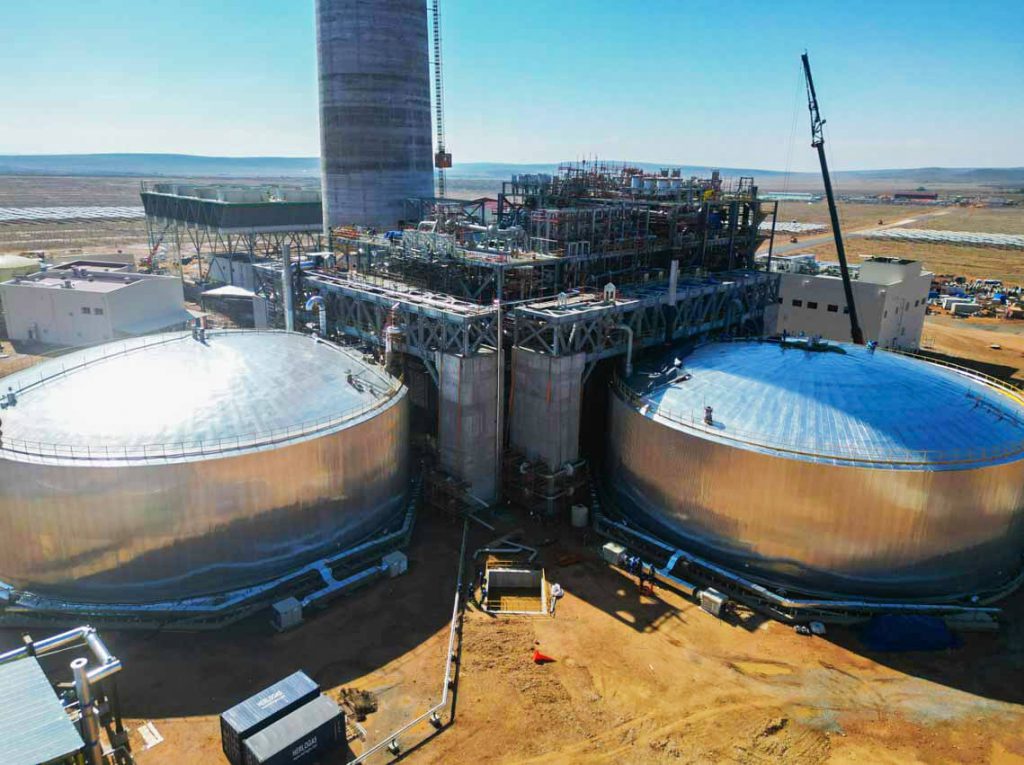
The central receiving tower, which is 250m tall, would be visible from a far greater distance. The most exposed area is the R385 provincial road.
Fire Safety
A full-time fire team will be available, with the requisite water, equipment, Personal Protective Equipment (PPE) and training. A Fire and Emergency response plan has been developed to further mitigate risk
Impact on birds
Potential impacts of the project on birds are of two types – those related to the CSP itself, and those relating to additional infrastructure have also been considered in particular regarding collision of birds structures and potential scorching.
Impact on threatened flora, fauna and tree species
All appropriate measures and monitoring activities will be undertaken during site clearance and construction activities, with focus on Alien Invasive Species management. We have designed and will implement a robust, appropriate, and long-term Biodiversity Monitoring Plan and evaluation program. An independent Environmental Control Officer will be monitoring and reporting on activities on site.
Security and Community Safety
The company has developed a comprehensive security protocol for its direct employees and security contractor(s) consistent with local and international standards including a site-specific Emergency Preparedness and Response Plan. A community safety plan has been developed to further mitigate risks.
Community health and HIV/AIDS awareness
We have, together with the EPC Contractor, developed and will implement protocols and programmes (including a HIV/AIDS plan, code of conduct etc.) for the health and wellness of all construction contractors, sub-contractors, and staff. This will be integrated into the induction process and the Human Resources Manual. As some contractors will use off-site accommodation, regular inspections and monitoring of these facilities will be conducted.
Rehabilitation of disturbed areas
An ecological approach to rehabilitation measures will be adopted wherever possible and a registered landscape architect will be contracted for the purpose of rehabilitation.
Cultural Heritage
The general Heritage Management Guideline outlined in the Heritage Impact Assessment will be followed, which is aligned with statutory requirements.
We are fully committed to regular engagements going forward to maintain regular, transparent communication with all stakeholders and to better understand any adverse impacts, to manage expectations about opportunities, identify the numbers of skilled and unskilled job opportunities targeted for the local communities, to work with local business and enterprises and to invest in socio-economic development initiatives. This pamphlet is intended to update all stakeholders on the latest developments on the project and would be followed by further community engagement meetings when possible given current COVID-19 restrictions. The community grievance procedure and forms will be placed at each community paypoint, and at the offices of Tsantsabane and Kgatelopele Municipalities.
Environmental and Social Impacts and Management System
- Stakeholder Engagement Plan
- Community Grievance Procedure
- Employee Grievance Procedure (for employees/contractors)
A stakeholder identification and analysis process was conducted with both Tsantsabane and Kgatelopele Local Municipalities; this was later vetted by the established Steering committee, established to maintain consistency between the two impacted municipalities and provide oversight under the oversight of the Office of the Provincial Premier. The identification process involved identifying all potential direct and indirect beneficiaries within a 50kms radius of the project including mapping them. In 2019 we convened several community engagement meetings within each community in both Tsantsabane and Kgatelopele. The following procedures will be utilized going forward as part of enhancing stakeholder engagement and ensuring transparency with all identified stakeholders.
These procedures together with other information will be made available to all stakeholders during engagement sessions and can also be obtained from the HR, Talent and SED Manager, Pulane Mogoere (PMogoere@acwapower.com):